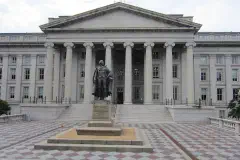
The Treasury starts buying back its own debt
The US Treasury has officially launched an innovative liquidity-support mechanism: its first regular sovereign debt buyback programme since the early 2000s.
The US Treasury has officially launched an innovative liquidity-support mechanism: its first regular sovereign debt buyback programme since the early 2000s.
At its May policy meeting, the Federal Reserve delivered an important structural adjustment to its monetary plumbing by announcing a substantial taper of its quantitative tightening (QT) programme.
Tokyo’s foreign exchange authorities have adopted an asymmetric, stealthy approach to currency market management.
Mark Zuckerberg discovered that Wall Street’s patience with open-ended technology capex has strict boundaries.
The sovereign bond market has executed a brutal capitulation.
First-quarter earnings from Wall Street’s banking titans demonstrated that premier financial institutions have adapted with remarkable agility to restrictive interest rates.
The yen has reached the danger zone, sliding toward 151.8 per dollar—its weakest level in thirty-four years.
The Bank of Japan delivered its first interest rate increase in seventeen years, yet the immediate market response was a counterintuitive slide in the domestic currency.
On 11 March, the Federal Reserve officially ceased issuing new loans under the Bank Term Funding Program (BTFP), terminating the emergency lending facility launched during the regional banking panic of 2023.
Capital One’s proposed $35.3 billion all-stock takeover of Discover Financial represents one of the most audacious banking consolidations since the 2008 financial crisis.
The quiet deterioration in commercial real estate debt is entering a critical phase across commercial mortgage-backed securities (CMBS).
On 22 February, Nvidia staged a display of market capitalization creation without historical precedent.
Fixed-income bulls received a rude awakening from the January consumer price index, as headline inflation printed at 3.1 per cent and core prices surged by an uncomfortably hot 0.4 per cent month-on-month.
Wall Street has long indulged in statistical folklore, none more enduring than the Super Bowl Indicator—the superstitious notion that an NFC victory predicts an equity bull market while an AFC win foretells a bear cycle.
As China enters the Year of the Dragon, domestic equity markets are finding little reason for celebratory animal spirits.
The US Treasury accomplished a masterclass in market psychology with its February quarterly refunding statement.
America’s premier banking institutions are paying the final financial bill for the regional banking panics of early 2023.
In the quiet corners of central bank plumbing, a lucrative arbitrage trade has flourished.
The concentration of the US stock market has reached proportions that challenge modern portfolio theory.
Wall Street enters 2024 in a state of euphoric anticipation, with forward markets pricing in six quarter-point interest rate reductions beginning as early as March.
While equity investors were enjoying eggnog and holiday rallies, money market desks were navigating the quiet, annual liquidity squeeze that accompanies year-end balance-sheet reporting.
The final trading days of December are traditionally greeted on Wall Street with mystical references to the 'Santa Claus rally'—the statistical tendency for equities to drift higher into year-end.
The Bank of Japan stands alone as the final holdout of negative interest rate policy.
Financial markets have fully embraced the fantasy of an immaculate macroeconomic landing.
Corporate financial officers have witnessed a miraculous transformation in borrowing conditions.
November 2023 will go down as one of the most explosive fixed-income rallies on record.
Black Friday arrived with an unfamiliar sight across American retail: tidy shelves, disciplined inventory, and the near-total absence of panic clearance sales.
As American families gathered for Thanksgiving, fixed-income fund managers enjoyed a rare moment of genuine gratitude.
Ask a macro hedge fund manager whether financial conditions are tight or loose, and the answer will depend entirely on which financial conditions index (FCI) they consult.
As millions celebrated Diwali across India, cash registers rang to the sound of an unprecedented consumer spending boom.
Fixed-income markets experienced one of their most explosive duration rallies in recent memory following the Treasury’s quarterly refunding announcement.
Confronted with a sovereign debt market on the verge of systemic indigestion and ten-year yields flirting with 5.0 per cent, the US Treasury executed a tactical retreat on 31 October.
Alphabet’s third-quarter earnings report delivered an instructive lesson in modern equity market unforgiveness.
The legendary bond vigilantes—the institutional investors who punish undisciplined sovereign borrowers by aggressively dumping their debt—have emerged from their three-decade hibernation.
On 19 October, the benchmark ten-year US Treasury yield touched 4.99 per cent, bringing the totemic 5.0 per cent threshold into direct sight for the first time since July 2007.
Beijing’s attempts to defuse its municipal debt crisis have entered an intricate phase of balance-sheet alchemy.
Third-quarter earnings reports from America’s premier banking institutions painted a superficially glittering picture.
The horrific Hamas attack on Israel on 7 October initially triggered the standard geopolitical playbook across trading desks: an instinctive flight to safe-haven assets, bidding up gold, crude oil, and US Treasuries.
The September employment report delivered an absolute blowout, with non-farm payrolls expanding by an astonishing 336,000 jobs—nearly double consensus forecasts.
A profound shift has occurred in the sovereign debt market.
The yen’s relentless slide toward 147 against the dollar has put currency traders on high alert for official intervention from the Ministry of Finance.
One year ago, this column commenced with a simple premise: that the most aggressive central bank tightening cycle in forty years would inevitably collide with private balance sheets.
For eighteen months, monetary orthodoxy insisted that cooling inflation required engineering a painful surge in unemployment.
The sovereign bond market has crossed a monumental psychological threshold.
Deflation is officially stalking the Chinese economy, and the People’s Bank of China faces an acute monetary trilemma.
The relentless ascent of ten-year Treasury yields toward 4.1 per cent has ignited a fierce theoretical debate across fixed-income desks.
The sovereign borrowing machine is accelerating, and the private sector is about to feel the draft.
In the banking sector, capital management has taken a pragmatic and defensive turn.