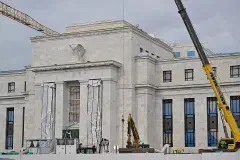
Trump moves to fire a Fed governor
The White House ignited an unprecedented constitutional and financial crisis on 25 August by initiating legal proceedings to dismiss Federal Reserve Governor Lisa Cook prior to the statutory expiration of her term.
The White House ignited an unprecedented constitutional and financial crisis on 25 August by initiating legal proceedings to dismiss Federal Reserve Governor Lisa Cook prior to the statutory expiration of her term.
The Japanese Government Bond (JGB) market, long regarded as the most docile and heavily suppressed sector of global sovereign debt, suffered a severe bout of volatility as 30-year yields surged to approximately 3.2 per cent.
Presidential signature of the Omnibus Budget and Balanced Border Act (OBBBA) officially raised the statutory federal debt ceiling by an astronomical $5 trillion, putting an end to months of political brinksmanship.
The United States Senate took a historic legislative step by passing the Guiding Electronic National Innovation and Uniform Standards (GENIUS) Act, establishing a formal federal regulatory framework for dollar-backed stablecoins.
Capitol Hill’s latest legislative draft sent an immediate chill through global capital markets: a proposed withholding tax surcharge of up to 20 per cent levied on foreign holdings of US corporate equity dividends and debt interest.
The United States lost its final pristine sovereign credit rating as Moody’s Investors Service downgraded the federal government’s long-term issuer rating from Aaa to Aa1 on 16 May.
The US Dollar Index collapsed to a three-year low near 98, fueling whispers of an institutional 'Sell America' wave across global foreign exchange and sovereign debt desks.
A multi-decade constant of global financial markets has evaporated: the US dollar is no longer functioning as an automatic safe haven during periods of macroeconomic turbulence.
The cardinal rule of modern risk management—that sovereign bonds provide a reliable hedging offset against equity portfolio drawdowns—broke down completely this week.
With minimal fanfare, the Federal Reserve executed a pivotal operational pivot in its quantitative tightening (QT) program.
The S&P 500 slipped into official market correction territory, dropping ten per cent from its recent highs, led downward not by speculative micro-caps or distressed cyclical debt, but by the market’s most celebrated corporate titans.
A multi-decade pillar of European fiscal austerity collapsed in a single trading session.
The Atlanta Fed’s widely followed GDPNow tracking model shocked financial markets by abruptly plunging to an annualized reading of −2.8 per cent for the first quarter.
Financial markets have undergone a decisive psychological pivot over the past fortnight: the primary driver of asset prices has shifted from inflation anxiety to acute growth deceleration fears.
Economic textbook orthodoxy dictates that when a large economy imposes across-the-board tariffs, its domestic currency must appreciate to restore external balance.
A sudden technological shock from Hangzhou shattered the core consensus governing modern equity valuation.
The yield on British 30-year government bonds has breached 5.47 per cent, touching levels not seen in twenty-seven years and sending severe warning signals through HM Treasury.
A headline non-farm payrolls gain of 256,000 for December delivered a resounding blow to bond investors betting on a rapid Federal Reserve easing campaign.
The suspension of the statutory US debt ceiling, negotiated in May 2023, officially terminates on 1 January 2025.
As the final trading session of 2024 concludes, foreign exchange markets can look back on an exceptional year of dollar supremacy.
As the calendar turns toward year-end, money market desks are once again navigating the predictable, mechanical volatility that plagues wholesale funding markets.
For financial markets hoping for an extended season of monetary goodwill, the Federal Reserve’s December policy package felt distinctly like a lump of coal in the stocking.
European sovereign bond markets crossed a historic, symbolic Rubicon on 28 November.
Black Friday shopping malls and e-commerce platforms buzzed with an unusual sense of urgency this year.
Corporate procurement managers across the United States have embarked on an aggressive inventory hoarding campaign.
As the US Dollar Index (DXY) marched back toward 107 in the wake of the US election, trade economists began evaluating a critical theoretical question: can a surging dollar neutralize the inflationary impact of proposed import tariffs?
The morning after Donald Trump’s electoral victory, equity markets delivered a spectacular divergence.
As election night returns confirmed Donald Trump’s decisive victory alongside a Republican sweep of Congress, the US sovereign bond market delivered an immediate, violent verdict.
On Halloween, bond investors were confronted with a genuine fixed-income horror show.
Tesla shares staged an explosive twenty-two per cent post-earnings rally after reporting a surprising expansion in third-quarter automotive gross margins to 17.1 per cent.
With the US presidential election approaching, fixed-income markets have succumbed to acute fiscal anxiety.
Third-quarter earnings from America’s premier commercial banks revealed that the margin windfall from restrictive interest rates is finally decelerating.
In one of the most counterintuitive market moves of recent years, the Federal Reserve’s jumbo 50-basis-point interest rate cut was immediately followed by a sharp surge in long-term borrowing costs.
Confronted with an intractable property slump, deepening deflation, and failing economic targets, Beijing finally abandoned its piecemeal stimulus approach.
As American workers celebrated Labor Day, the domestic labor market stood at a precarious cyclical crossroads.
The US sovereign yield curve staged an important structural milestone on 5 August, as the spread between two-year and ten-year Treasury yields briefly turned positive for the first time since July 2022.
The violent global market dislocation of early August was not caused by geopolitical conflict or corporate insolvency; it was the mathematical unwinding of the global yen carry trade.
The Bank of Japan delivered a bold, surprising monetary strike on 31 July by raising its benchmark interest rate to 0.25 per cent and announcing plans to halve its monthly bond purchases.
Tokyo’s currency authorities executed another aggressive foreign exchange intervention on 11 July, stepping in immediately following the release of softer-than-expected US consumer price inflation.
As the United States celebrates Independence Day, the global financial architecture is quietly contemplating the durability of American monetary hegemony.
The 'Trump trade' has taken command of fixed-income trading desks.
The presidential debate on 27 June between Joe Biden and Donald Trump delivered a profound shock that reverberated far beyond political circles.
On 18 June, Nvidia achieved a corporate milestone that was unthinkable two years ago: it surpassed Microsoft to become the most valuable public corporation in the world, touching a staggering market valuation of $3.34 trillion.
The spread between French ten-year sovereign debt and German Bunds has blown out to eighty basis points—its widest level since the sovereign debt crisis of 2012.
Emmanuel Macron’s shock decision to dissolve the National Assembly and call snap parliamentary elections following a crushing defeat in European elections sent European sovereign debt markets into an immediate panic.
On 5 June, Nvidia crossed another monumental financial threshold, surpassing $3 trillion in market capitalization and overtaking Apple as the second most valuable corporation on earth.
With euro short-term rate (€STR) futures pricing a near-certainty of a 25-basis-point rate cut at the European Central Bank’s 6 June meeting, foreign exchange desks are positioning for transatlantic divergence.